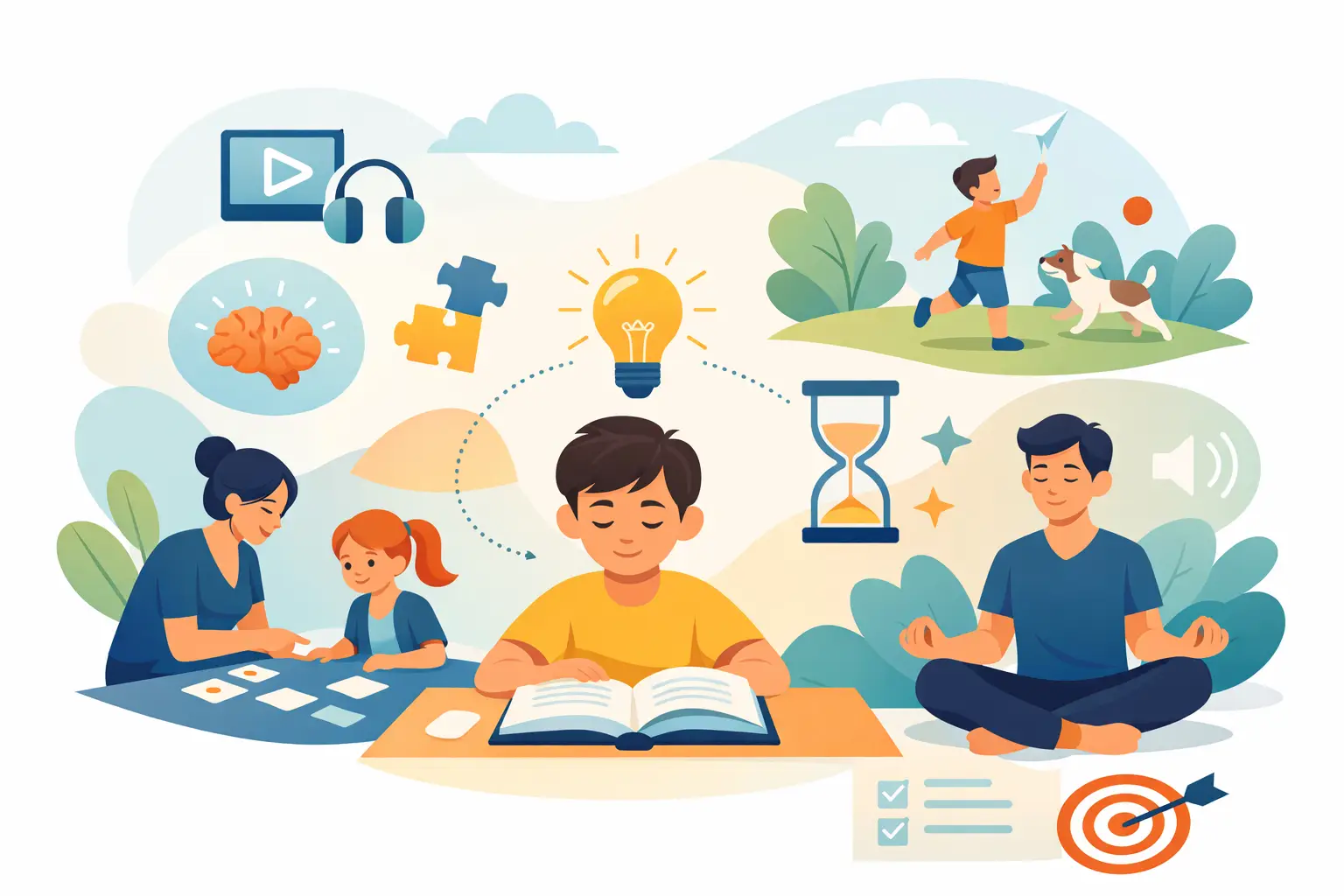
A child who loses track of a three-step instruction is not necessarily being defiant or careless. They may be working hard to listen while their brain is also managing noise, movement, worry, tiredness, or an overwhelming task. Parents often search for children attention support methods when homework becomes a daily battle, teachers report distractibility, or a child starts believing they are “bad at school.” The most helpful approach begins with curiosity, not blame.
Attention is not a single skill that children either have or do not have. It is a group of abilities that includes starting a task, filtering distractions, holding information in mind, shifting between activities, and returning to focus after an interruption. Supporting attention means looking at the child, the environment, and the nervous system together.
Why attention can be difficult for children
A child’s ability to focus changes from day to day. Sleep, hunger, illness, family stress, sensory overload, screen habits, classroom demands, and developmental stage can all affect how well they regulate attention. A child may concentrate deeply on building blocks or video games yet struggle with worksheets because those activities place very different demands on motivation, movement, and working memory.
Sometimes persistent attention challenges are connected to ADHD, anxiety, learning differences, sleep difficulties, sensory processing concerns, or emotional stress. These possibilities should not be assumed from one difficult week or a teacher comment alone. Patterns over time, across settings, and alongside other behaviors provide much more useful information.
For parents, the key question is not simply, “How do I make my child sit still?” It is, “What makes focus harder for my child, and what support helps them feel capable?” That shift can protect confidence while creating room for meaningful progress.
Children attention support methods to use at home
Home routines can reduce the amount of self-control a child must use before they even begin a task. The goal is not to create a rigid household. It is to make expectations visible, manageable, and predictable.
Make tasks smaller and more concrete
“Finish your homework” can feel enormous, particularly for a child who has trouble organizing, reading, or getting started. Offer one clear step at a time: “Put your math book on the table,” then “Complete questions one through three.” A short visual checklist can be more effective than repeating verbal reminders.
Use a timer as a supportive boundary rather than a threat. For example, a child might work for 10 to 15 minutes, take a brief movement break, and return for another round. The right interval depends on age, fatigue, and the difficulty of the task. Younger children may need shorter cycles, while an older child might do well with 20 focused minutes.
Create a low-distraction work zone
A helpful study space does not need to be perfect or expensive. It should be consistent, reasonably quiet, and stocked with the materials the child needs. Reduce visual clutter where possible and keep toys, phones, and unrelated tabs out of reach during work periods.
Some children focus better with gentle background sound, noise-reducing headphones, or a seat that allows subtle movement. Others need complete quiet. Treat the environment as an experiment. Notice what improves task completion and what leads to more frustration.
Build movement into the routine
Movement is not the opposite of attention. For many children, it helps regulate energy and prepares the brain to learn. A few minutes of jumping, stretching, walking, dancing, or carrying books before homework can make it easier to settle afterward.
Movement breaks work best when they are planned. If a child only leaves the table after becoming upset, breaks can accidentally become an escape from every challenging task. A predictable rhythm teaches that effort and rest can work together.
Use connection before correction
When a child is overwhelmed, repeated instructions often increase pressure without improving focus. Start with calm connection: sit nearby, name what you see, and help them choose the first step. “This looks like a lot. Let’s begin with the heading together” is more likely to support regulation than “You need to pay attention.”
Praise should be specific and honest. Rather than offering a general “good job,” acknowledge the skill: “You came back to the worksheet after your break,” or “You asked for help before getting stuck.” This helps children recognize focus as a practice they can strengthen.
Support attention at school without adding pressure
Parents and teachers are strongest when they share observations instead of assigning labels. A child may struggle most during transitions, independent written work, long verbal directions, or noisy group activities. Those details point toward practical accommodations.
Useful classroom supports may include sitting closer to the teacher, receiving directions in writing and verbally, breaking larger assignments into checkpoints, having access to movement breaks, and using visual schedules. For children with learning differences, an evaluation can also clarify whether the task itself is asking for skills that need targeted support.
It helps to set one or two measurable goals at a time. For instance, a child may work toward starting independent work within five minutes or completing a short assignment with one reminder. Small goals make progress visible and reduce the discouragement that can come from broad expectations such as “focus more.”
Protect the foundations of a focused brain
No attention strategy can fully compensate for chronic sleep loss, an irregular routine, or a child who is carrying significant emotional stress. Consistent sleep and wake times, nourishing meals, hydration, daily physical activity, and time away from overstimulating media all contribute to nervous system regulation.
Screen use deserves a balanced conversation. Digital tools can be educational, social, and relaxing, but fast-paced content and late-night use may make transitions and sleep more difficult for some children. Instead of treating screens as the only cause of attention problems, notice the pattern. Does behavior change after certain games, at particular times of day, or when devices replace sleep, outdoor play, or family connection?
Emotional language is another foundation. Children who can say, “My brain feels busy,” “I am worried about getting this wrong,” or “I need a short break,” have more options than children who can only show distress through avoidance or anger.
When attention needs a more personalized assessment
Consider professional guidance when challenges persist for several months, affect school or relationships, cause frequent emotional distress, or occur across home and classroom settings. A comprehensive assessment can help distinguish between attention regulation difficulties and concerns such as anxiety, learning challenges, sleep disruption, hearing or vision issues, and developmental differences.
Medication is one option some families consider with a qualified medical provider, and for some children it can be beneficial. Other families prefer to begin with behavioral, educational, and nervous system-focused support. These paths are not always mutually exclusive. The appropriate plan depends on the child’s needs, health history, goals, and response to care.
At Positive Living UAE, an individualized approach may include counseling, coaching, and neurofeedback when clinically appropriate. Neurofeedback is a non-invasive form of brain training that uses EEG feedback to help the brain practice healthier patterns of regulation. It is often described as a gym for the brain: the child is not forced to concentrate, but receives real-time feedback that encourages more efficient brain activity over repeated sessions.
A QEEG brain map may be used to better understand patterns linked to attention, emotional regulation, sleep, or cognitive performance and to guide a personalized protocol. Progress should be reviewed through parent and child feedback, symptom tracking, and structured evaluations, not promises of a quick fix. Neurofeedback can be a valuable drug-free support for some children, but outcomes vary and it works best as part of a thoughtful, child-centered plan.
What progress can look like
Progress is often quieter than parents expect. It may look like fewer arguments before homework, a child recovering more quickly after distraction, improved sleep, or a teacher noting that they need fewer reminders. These changes matter because attention is closely tied to self-esteem. Every successful return to a task helps a child learn, “I can handle this.”
Avoid measuring success only by perfect grades or long periods of stillness. A child who asks for a break appropriately, uses a checklist independently, or completes one difficult task without shutting down is building skills that can support them well beyond the classroom.
Your child does not need to earn patience by focusing perfectly. With compassionate structure, informed assessment, and support that fits their individual brain, attention can become less of a daily conflict and more of a skill they learn to trust.