A child who understands a lesson at home but freezes during a timed worksheet is not necessarily unmotivated. An adult who rereads the same email five times is not necessarily careless. Learning difficulties can reflect a brain working under strain – from inconsistent attention and slow processing to anxiety, poor sleep, or trouble regulating emotions. Learning difficulties brain therapy aims to understand those patterns and support the skills that make learning feel more manageable.
At Positive Living UAE, neurofeedback is approached as one part of a personalized, compassionate care pathway. It is not a shortcut, a diagnosis, or a replacement for educational support. It is a non-invasive way to train brain activity patterns that may be affecting focus, emotional regulation, sleep, and cognitive stamina.
Why learning difficulties need an individual approach
“Learning difficulties” is a broad phrase. A student may struggle to read fluently, remember instructions, organize written work, stay seated, understand math concepts, or complete tasks without becoming overwhelmed. Two people can have the same school concern while needing very different support.
Sometimes the main issue is a specific learning disorder, such as dyslexia or dyscalculia, which calls for evidence-based academic instruction and accommodations. In other cases, ADHD, anxiety, sensory overload, sleep disruption, depression, migraines, or chronic stress is making it harder to access existing abilities. These challenges also frequently overlap.
That is why a thoughtful plan begins with questions, not assumptions. When did the difficulty begin? Does it appear across settings or mainly during school and work demands? How are sleep, mood, behavior, confidence, and family stress? Has hearing, vision, medical health, or developmental history been reviewed? Clear answers help ensure that therapy is working alongside the right educational, medical, and psychological support.
What learning difficulties brain therapy can involve
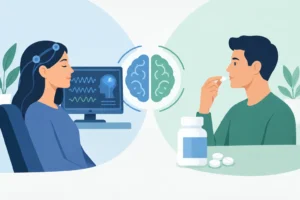
Brain-based therapy is an umbrella term. Depending on the person and the clinic, it may include cognitive training, counseling, behavioral strategies, occupational or speech therapy referrals, and neurofeedback. The right combination depends on what is getting in the way of learning.
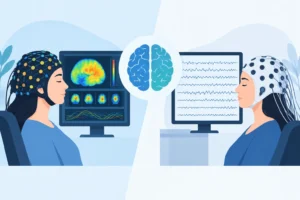
Neurofeedback is a form of EEG-based brain training. Small sensors are placed on the scalp to measure electrical activity. They do not send electricity into the brain, hurt, or require medication. The information is used by a computer program to provide immediate feedback – often through visuals, sound, or a video that responds as the brain moves toward an individualized training target.
A helpful analogy is a gym for the brain. Just as physical training gives muscles repeated practice under the right conditions, neurofeedback gives the brain repeated practice recognizing and sustaining more regulated patterns. Over time, some clients report better focus, calmer reactions, improved sleep, or greater mental endurance. Results vary, and progress is usually gradual rather than dramatic after one session.
The role of QEEG brain mapping
A QEEG, or quantitative EEG, can add useful context before a neurofeedback program begins. It records brainwave activity and compares patterns across different areas of the brain. A trained practitioner interprets this information alongside a detailed clinical history, symptoms, goals, and other relevant assessments.
A brain map should never be treated as a standalone label or a crystal ball. It does not diagnose dyslexia, ADHD, or a mental health condition by itself. Its value is in helping a qualified clinician make training more individualized rather than relying on a one-size-fits-all protocol.
For a child who loses focus during reading, for example, the plan may look different from that of a high-performing professional whose burnout has affected memory and concentration. Follow-up evaluations and symptom tracking help the practitioner see whether the plan is supporting meaningful changes in daily life.
What neurofeedback may support
When attention, regulation, or recovery are contributing to academic or workplace struggles, neurofeedback may support the foundation on which learning happens. Potential areas of improvement can include:
- Sustaining attention for schoolwork, meetings, and everyday tasks
- Managing impulsivity, restlessness, and emotional outbursts
- Falling asleep more easily and waking with better mental energy
- Reducing the mental load of anxiety, stress, or overwhelm
- Improving confidence after repeated experiences of frustration
These benefits are not guarantees, and they do not mean neurofeedback “cures” a learning disorder. A child with dyslexia will still benefit from structured literacy instruction. A student with ADHD may still need classroom accommodations, parent support, counseling, or medical guidance. For many families, the most constructive question is not, “What single treatment will fix everything?” It is, “What support will help this person learn, cope, and participate more fully?”
What a well-run program looks like
Quality matters in learning difficulties brain therapy. A responsible provider should explain what neurofeedback can and cannot do, review health history, set measurable goals, and monitor progress throughout care. The process should feel collaborative, especially when a child is involved.
A typical program starts with a consultation. This is a chance to discuss concerns, previous assessments, medication use, sleep, school or work demands, and desired outcomes. If neurofeedback appears appropriate, the practitioner may recommend a QEEG brain map and a structured series of sessions.
During sessions, clients generally sit comfortably while receiving real-time feedback from the EEG system. Younger children may engage with age-appropriate animations or games, while adults may prefer a calm visual program. Sessions are usually easy to fit into a regular routine, but consistency matters. Brain training is a process of practice, and the number of sessions depends on the person’s goals, response, and complexity of needs.
Progress should be measured beyond the screen. Parents might notice fewer homework battles or smoother mornings. An adult may find it easier to finish reports without mental exhaustion. A student might recover more quickly after making a mistake. These functional changes, combined with structured check-ins, are more meaningful than vague promises of “better brain function.”
Safety, evidence, and realistic expectations
Neurofeedback is generally considered non-invasive and medication-free when provided by appropriately trained professionals. Some people experience temporary tiredness, mild headache, or changes in sleep as their training protocol is adjusted. These effects should be discussed and monitored, not dismissed.
Research on neurofeedback is promising in areas such as attention regulation and ADHD symptoms, but findings vary by protocol, study design, and individual. It should be presented as a supportive therapeutic option, not a miracle solution. Equipment may be FDA-cleared for specific uses, but that does not mean every device or protocol is FDA-approved to treat every learning challenge.
The strongest care plans respect this nuance. They coordinate, when needed, with physicians, psychologists, school professionals, and learning specialists. Counseling or coaching can help address self-esteem, motivation, and the emotional impact of struggling. Practical changes – regular sleep, movement, manageable study routines, and accommodations – also give the brain a better environment in which to learn.
When to seek a professional assessment
It is worth seeking guidance when learning or focus challenges are persistent, worsening, or affecting confidence, relationships, school attendance, or work performance. Sudden changes in memory, behavior, headaches, language, or coordination require prompt medical evaluation.
For parents, early support can prevent a child from internalizing the painful belief that they are lazy or incapable. For adults, assessment can bring clarity to struggles that have been hidden for years. The goal is not to force every brain to work the same way. It is to identify barriers, build practical skills, and create conditions where a person can show what they are capable of.
A thoughtful consultation can be the beginning of that shift: less blame, more understanding, and a plan that respects both the science of the brain and the person living with the challenge.