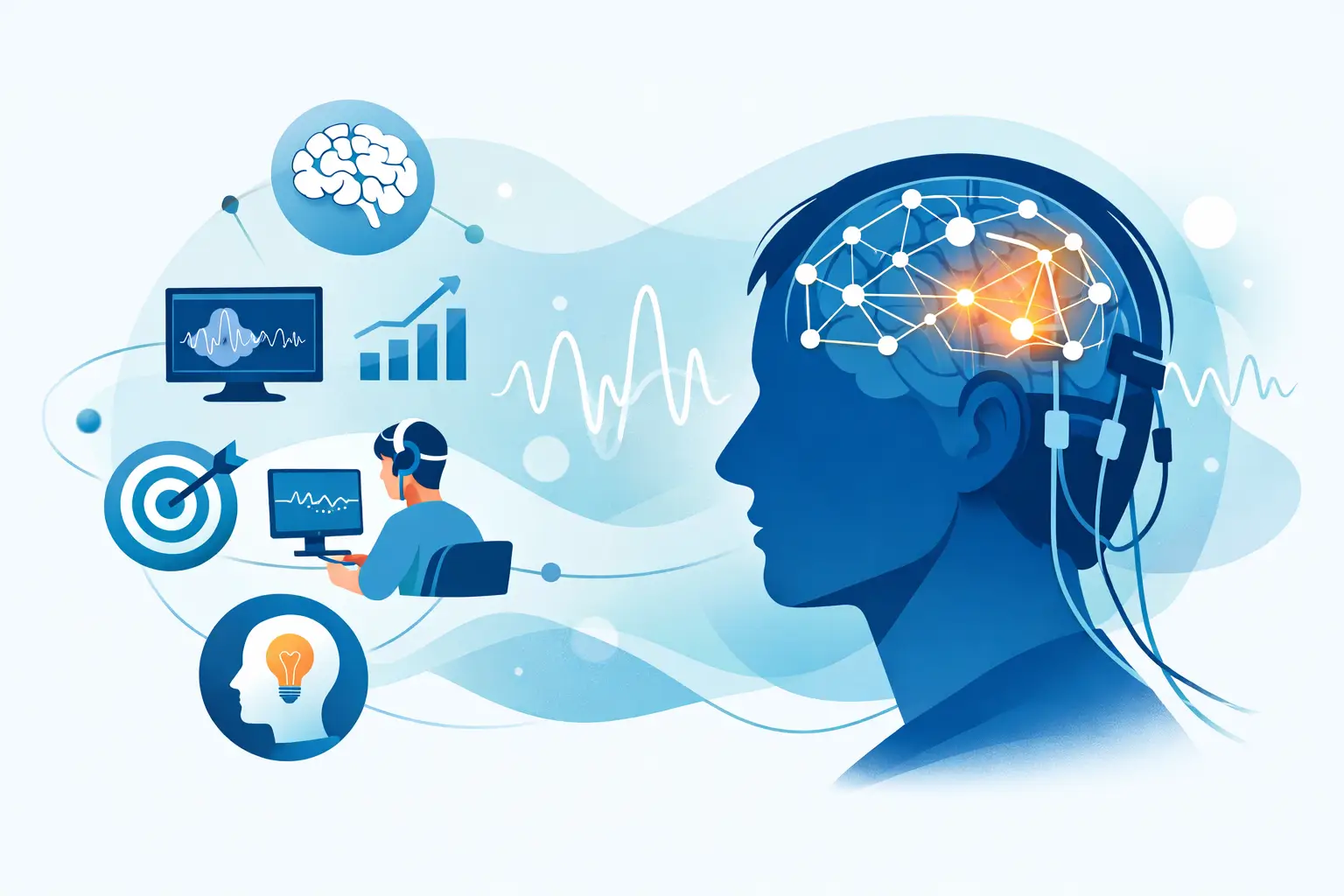
Mental sharpness rarely fails all at once. More often, it slips in small ways – trouble staying on task, slower recall, mental fatigue by midafternoon, or a sense that your brain is working harder than it should. Cognitive performance neurofeedback is designed for exactly this kind of challenge. It gives the brain real-time information about its own activity, then trains it toward healthier, more efficient patterns linked to focus, memory, emotional control, and sustained mental energy.
What cognitive performance neurofeedback actually does
A simple way to think about neurofeedback is as a gym for your brain. During sessions, sensors are placed on the scalp to read brainwave activity. This is non-invasive and does not put anything into the body. The system monitors how the brain is functioning in real time and uses audio or visual cues to reward more balanced patterns.
Over repeated sessions, the brain learns through practice. Just as physical training improves movement through repetition, neurofeedback helps the nervous system become more flexible and efficient. That matters for cognitive performance because attention, processing speed, working memory, and mental endurance all depend on how well different brain networks regulate themselves.
For some people, the issue is underactivation. They feel foggy, distractible, or mentally slow. For others, it is overactivation. Their mind races, stress stays high, and concentration breaks down under pressure. In both cases, the goal is not to force the brain into a single state. The goal is to help it shift appropriately and recover more easily.
Why brain performance is not just about intelligence
People often assume cognitive struggles mean they are not capable enough, disciplined enough, or motivated enough. In clinical practice, that is rarely the full picture. A bright child may have trouble sustaining attention in class because their brain has difficulty regulating arousal. A successful executive may lose mental clarity after months of stress because the nervous system is stuck in overdrive. A senior may notice slower processing that is made worse by poor sleep and chronic tension.
Cognitive performance depends on timing, regulation, and resilience as much as raw ability. If the brain is constantly pulled toward distraction, fatigue, anxiety, or poor sleep, performance suffers even when knowledge and potential are still there. This is one reason neurofeedback appeals to people who want more than temporary symptom relief. It aims to train the underlying patterns that influence daily mental functioning.
Who can benefit from cognitive performance neurofeedback
This kind of training can support a wide range of people because cognitive performance is relevant at every stage of life. Children with attention or learning challenges may benefit when they struggle to stay engaged, organize information, or manage frustration around schoolwork. Adults often seek support when work demands exceed their mental stamina, especially during burnout, sleep disruption, or prolonged stress. High performers may use neurofeedback to improve consistency under pressure rather than to fix a diagnosed condition.
Older adults can also benefit when the goal is to support attention, memory, and mental clarity in a proactive way. That said, expectations should stay realistic. Neurofeedback is not a magic shortcut, and results vary based on the person, the protocol, and the presence of other factors such as trauma, medication effects, hormones, sleep quality, or medical conditions.
How assessment shapes better results
One of the biggest differences between generic brain training and clinically guided neurofeedback is personalization. Not every focus problem comes from the same brain pattern, and not every memory complaint should be trained in the same way. That is why a thoughtful assessment matters.
A QEEG brain map can help identify areas where brainwave activity may be dysregulated compared with age-based norms. This does not replace broader clinical judgment, but it can provide useful guidance. Combined with a detailed intake, symptom history, and performance goals, it allows practitioners to build a protocol around the person rather than around a label.
This is especially important for clients whose cognitive symptoms overlap with anxiety, ADHD, burnout, depression, or sleep problems. For example, poor focus may improve most when the protocol first targets hyperarousal and sleep regulation. In another person, attention may improve when the training addresses underactivation and slow processing. The same symptom can have very different roots.
What a neurofeedback program typically feels like
Most people are relieved to learn that sessions are comfortable and medication-free. You sit back while the system reads your brain activity and responds to it through feedback on a screen or through sound. The experience is not about trying harder. In fact, forcing it usually does not help. The process works best when the brain receives clear feedback and gradually learns from it.
Changes can show up in subtle ways at first. A parent may notice homework takes less effort. A professional may realize they are recovering faster after meetings and making fewer careless mistakes. Someone dealing with mental fatigue may find they can stay present later in the day without the same crash.
The timeline is not identical for everyone. Some clients notice early shifts in sleep, calmness, or mental clarity. Others improve more gradually over a series of sessions. Progress is usually monitored through symptom tracking, behavioral observations, and periodic reevaluation so the protocol can be adjusted when needed.
Cognitive performance neurofeedback and real-life outcomes
The value of cognitive performance neurofeedback is not just sharper test scores or better productivity metrics. It often shows up in the moments that shape daily life: reading without rereading the same paragraph, staying calm enough to think clearly during pressure, remembering what matters, or feeling mentally available for conversations at home after a demanding workday.
This is where a broader wellness model can make a meaningful difference. If someone has cognitive symptoms driven by chronic stress, perfectionism, unresolved emotional strain, or poor self-regulation, neurofeedback may work best alongside counseling or coaching. Brain training can improve regulation, but sustainable change often grows faster when emotional and behavioral patterns are addressed at the same time.
That integrated perspective is one reason many clients seek care in a setting like Positive Living UAE, where neurofeedback can be supported by other therapeutic approaches under professional guidance. For some, the combination creates a more complete path forward than a single modality on its own.
Benefits, limits, and what to ask before starting
The strongest reasons people choose neurofeedback are clear. It is non-invasive, drug-free, personalized, and designed to support measurable improvements in how the brain regulates itself. Many clients appreciate that it does not ask them to suppress symptoms for a few hours. Instead, it aims to build better function over time.
Still, thoughtful expectations matter. Neurofeedback is a training process, not an instant fix. It requires consistency. It also depends on practitioner skill, quality assessment, and careful protocol design. If a provider makes sweeping promises, treats every client the same way, or skips meaningful evaluation, that is a reason to pause.
It is reasonable to ask how progress will be tracked, whether QEEG or other assessments are used, how protocols are adapted, and what professional oversight is involved. You can also ask how the provider handles cases where cognitive symptoms are tied to anxiety, trauma, sleep disruption, or medical factors. Good care is rarely one-size-fits-all.
Why this approach matters now
Modern life asks for sustained attention while constantly interrupting it. It rewards speed while draining recovery. Many people are not lacking ambition or ability. They are carrying a nervous system that has been pushed beyond its ideal operating range for too long.
That is why neurofeedback has become so relevant for cognitive performance. It respects the brain as something trainable. It offers a path that is grounded in measurable data, guided by clinical expertise, and centered on the individual rather than the symptom alone. For children trying to learn, adults trying to function at their best, and seniors trying to stay mentally engaged, that can be deeply encouraging.
A stronger mind is not always built by pushing harder. Sometimes it begins by helping the brain learn a better rhythm – one that supports focus, steadiness, and clearer thinking when life asks the most of you.