Individual Therapy vs Couples Therapy: Learn the key differences and how to choose the right therapy for your personal or relationship needs.
Individual therapy focuses on an individual’s psychological health, personal growth, and emotional regulation, while couples therapy treats the relationship dynamic as the client’s to resolve conflict, rebuild intimacy, and refine communication patterns. Deciding between individual and couples therapy depends on whether the primary source of distress is an internal mental health struggle or an interactive conflict pattern between partners.
Understanding the Core Difference: Focus, Client, and Objective
Individual therapy treats one person’s internal psychological landscape, treating issues like depression, anxiety, trauma, and personal goal-setting. In contrast, couples therapy treats the relationship dynamic itself as the patient, focusing on communication patterns, conflict resolution, intimacy, and shared relational goals.
In individual therapy, the clinician’s sole allegiance is to the individual client’s personal well-being and self-actualisation. In couples therapy, the therapist maintains absolute neutrality, serving as an objective facilitator who observes how two individual personalities interact, miscommunicate, or trigger one another.
Understanding which modality aligns with your needs requires examining how key operational variables differ across both approaches.
Clinical Comparison: Individual vs Couples Therapy
| Feature | Individual Therapy | Couples Therapy |
| Primary Client | The single individual. | The relationship dynamic between partners. |
| Core Objective | Personal healing, self-awareness, emotional regulation, processing trauma. | Conflict resolution, communication repair, rebuilding trust, deepening intimacy. |
| Primary Modalities | Cognitive Behavioural Therapy (CBT), EMDR, Psychodynamic, Acceptance & Commitment Therapy (ACT). | Gottman Method Couples Therapy, Emotionally Focused Therapy (EFT), Imago Relationship Therapy. |
| Confidentiality | Absolute privacy between the client and therapist. | Shared therapeutic space; “no secrets” policy applies between partners. |
| Ideal For | Personal mental health conditions, childhood trauma, self-worth, career burnout. | Repeated arguments, emotional distance, infidelity recovery, parenting disagreements. |
When Individual Therapy Is the Better Choice
Individual therapy is the primary recommendation when emotional distress stems from personal mental health conditions, unprocessed childhood trauma, or individual coping mechanisms that exist independently of the current relationship dynamic. It provides a private environment to build emotional self-regulation and self-awareness without external pressure.
Choosing individual therapy first is crucial when personal struggles heavily affect your daily functioning or when relationship therapy cannot safely proceed.
- Managing Personal Mental Health Conditions: If you are navigating clinical depression, generalised anxiety, severe grief, or ADHD, individual therapy provides the specialised intervention needed to stabilise your mental health.
- Processing Individual Trauma: Unresolved childhood trauma or past abuse often causes intense relational triggers. Individual modalities like EMDR or trauma-focused therapy allow you to process these memories safely.
- Safety Concerns and Active Abuse: Couples therapy requires emotional vulnerability and mutual safety. If a relationship involves active domestic violence, coercive control, or unmanaged severe addiction, individual therapy is required to establish personal safety and boundaries first.
- Uncertainty About Staying in the Relationship: If you are undecided about whether you want to remain in the partnership, individual therapy offers a confidential space to gain clarity without escalating conflict or hurting your partner prematurely.
Therapist Pro Tip: A relationship cannot be healthier than the two individuals within it. Doing personal work in individual therapy equips you with emotional self-regulation, making future relationship work significantly more productive.
When Couples Therapy Is the Better Choice
Couples therapy is the ideal treatment option when emotional distress is generated by the interaction patterns between partners, such as chronic arguments, broken trust, emotional detachment, or sexual dissatisfaction. It addresses the communication breakdowns and attachment ruptures that occur when two people try to navigate life together.
When relationship distress is driven by mutual misinterpretations or reactive cycles, individual therapy alone may prove insufficient.
- Repetitive Conflict Cycles: You find yourselves having the exact same argument repeatedly without reaching a resolution or compromise.
- Communication Breakdown: Interaction has become transactional, hostile, critical, or marked by long periods of stonewalling and emotional silence.
- Recovering from Infidelity or Trust Ruptures: Rebuilding trust after emotional or physical infidelity requires guided, transparent dialogues that only a structured couples therapy framework can facilitate.
- Navigating Life Transitions: Major milestones—such as adjusting to parenthood, career pivots, or relocating—create stress that requires shared alignment and renegotiated roles.
Can You Do Both Simultaneously? The Dual Therapy Framework
Combining individual and couples therapy simultaneously can accelerate therapeutic progress when personal mental health challenges and relational conflict overlap. However, executing dual therapy requires clear ethical boundaries, separate clinicians, and structured communication protocols to protect therapeutic integrity.
While combining both formats offers a comprehensive path to healing, it must be approached with an understanding of clinical ethics:
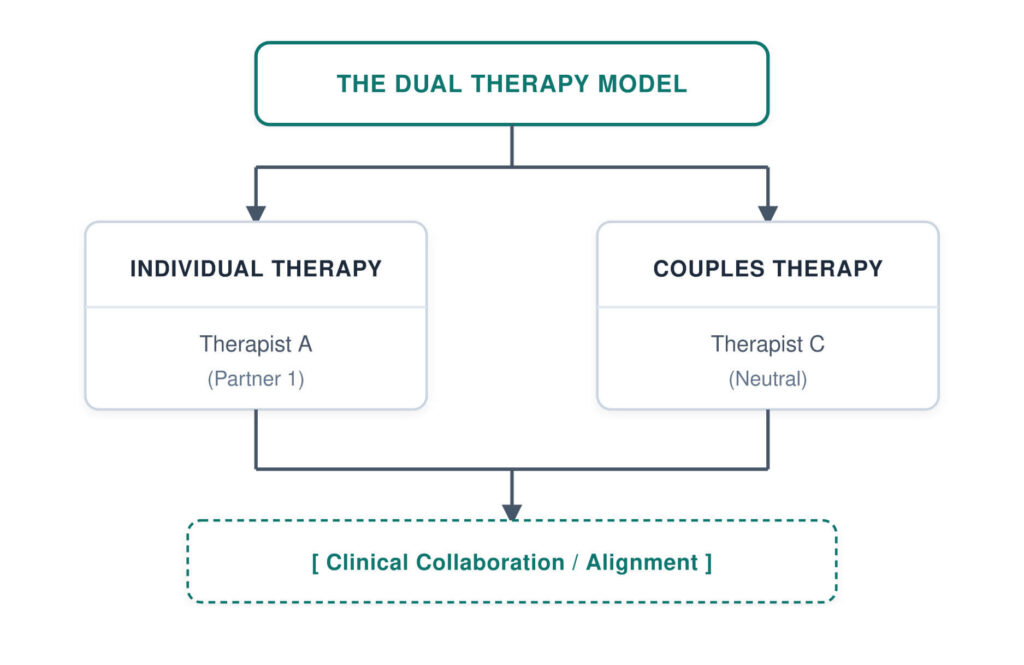
- The Separate Therapist Rule: Except under rare, short-term psychoeducational circumstances, the same therapist should not conduct both individual therapy and couples therapy for a couple. Treating an individual privately creates potential conflicts of interest and threatens the therapist’s perceived neutrality during joint sessions.
- The “Secrets Policy” in Couples Work: Couples therapists maintain a “no secrets” policy. If one partner reveals significant undisclosed information (e.g., an ongoing affair) during an individual check-in, the couples therapist cannot keep that secret from the other partner, as doing so compromises therapeutic trust.
- Clinical Collaboration: With written client consent, your individual therapist and couples therapist can occasionally liaise to align treatment goals, ensuring that individual growth directly supports relational stability.
Relational Dynamics in the UAE: Why Context Matters in Dubai
Relationships in Dubai and the wider UAE contend with specific socio-cultural dynamics, such as high-stress corporate environments, distance from home country support networks, and intercultural marriage complexities. These localised factors heavily influence whether individual or joint therapy should be prioritised.
Living and working in the UAE introduces specific pressures that require culturally sensitive, professional psychological support:
- Expat Isolation and Support Deficits: Relocating to the UAE often separates couples from extended families and lifelong friends. When external support systems are absent, partners place immense emotional pressure on one another. Individual therapy helps partners build internal resilience, while couples therapy helps construct a resilient partnership.
- High-Demand Career Pressures: Fast-paced corporate environments in the UAE frequently result in burnout and emotional exhaustion. Individual therapy addresses career stress and burnout, preventing workplace exhaustion from manifesting as relational irritability at home.
- Intercultural Communication Norms: Dubai is home to over 200 nationalities. Intercultural relationships often face differing communication styles, family boundaries, and cultural expectations. Couples therapy provides a neutral space to bridge cultural differences and align on shared values.
Seek Support Early at Positive Living UAE
Whether you are navigating personal emotional challenges or seeking to restore closeness in your marriage, Positive Living UAE offers confidential individual and couples counselling tailored to the realities of living in the Emirates.
How to Decide: A Step-by-Step Decision Framework
Choosing between individual therapy and couples therapy can be straightforward when broken down into a structured diagnostic assessment. Follow this step-by-step framework to identify the right starting point for your situation.
- Identify the Core Source of Distress: Ask yourself, “If my relationship were completely healthy tomorrow, would I still be struggling with my own mental health, mood, or anxiety?” If yes, start with Individual Therapy. If the distress exists exclusively when interacting with your partner, choose Couples Therapy.
- Assess Partner Readiness: Are both partners willing, emotionally ready, and available to attend sessions and practice new habits? If both agree, proceed with Couples Therapy. If one partner refuses, start with Individual Therapy to focus on your own communication boundaries and emotional regulation.
- Evaluate Safety and Stability: Is there active unmanaged substance addiction, domestic abuse, or ongoing secret infidelity? If any of these are present, Individual Therapy must be prioritized to ensure personal safety and individual support.
- Consider a Combined Approach: If you are working through personal depression or past trauma while simultaneously experiencing major relationship friction, schedule an initial consultation to discuss a structured, dual-therapy plan.
Frequently Asked Questions (FAQ)
Is couples therapy better than individual therapy for resolving communication problems?
Yes, couples therapy is generally more effective for fixing communication breakdowns because it allows a clinician to observe and intervene in real-time interactions between partners. While individual therapy helps you understand your personal communication style, couples therapy actively trains both partners in shared dialogue tools, active listening, and conflict de-escalation.
Can individual therapy accidentally ruin a relationship?
Individual therapy is designed to promote personal health and self-awareness. While it can empower an individual to establish healthy boundaries or leave an unhealthy dynamic, it generally strengthens healthy relationships by helping individual partners become more self-aware, emotionally regulated, and communicative.
What should we do if my partner refuses to go to couples therapy?
If your partner is unwilling to attend joint sessions, you should begin with individual therapy. Working on your own responses, emotional regulation, and communication boundaries alters the relational dynamic and often encourages a hesitant partner to participate in therapy later.
Can one therapist conduct both individual therapy and couples therapy for us?
In professional clinical practice, it is generally advised to have separate therapists for individual work and couples counselling. Using separate clinicians protects therapist neutrality during joint sessions and ensures that individual privacy and confidentiality boundaries are maintained.
Begin Your Healing Journey with Positive Living UAE
Choosing the right therapeutic path is the first step toward lasting emotional well-being and relational harmony. At Positive Living UAE, our holistic center in Dubai provides compassionate, evidence-based individual therapy and couples counselling tailored to your unique needs. Whether you need one-on-one support for personal growth or joint therapy to rebuild trust and communication, our licensed therapists are here to guide you.
- Location: Dubai, United Arab Emirates
- Services: Individual Psychotherapy, Couples & Marriage Counselling, Holistic Wellness Services
Book Your Confidential Consultation Today
Take the first step toward emotional clarity and stronger, healthier connections with Positive Living UAE.